
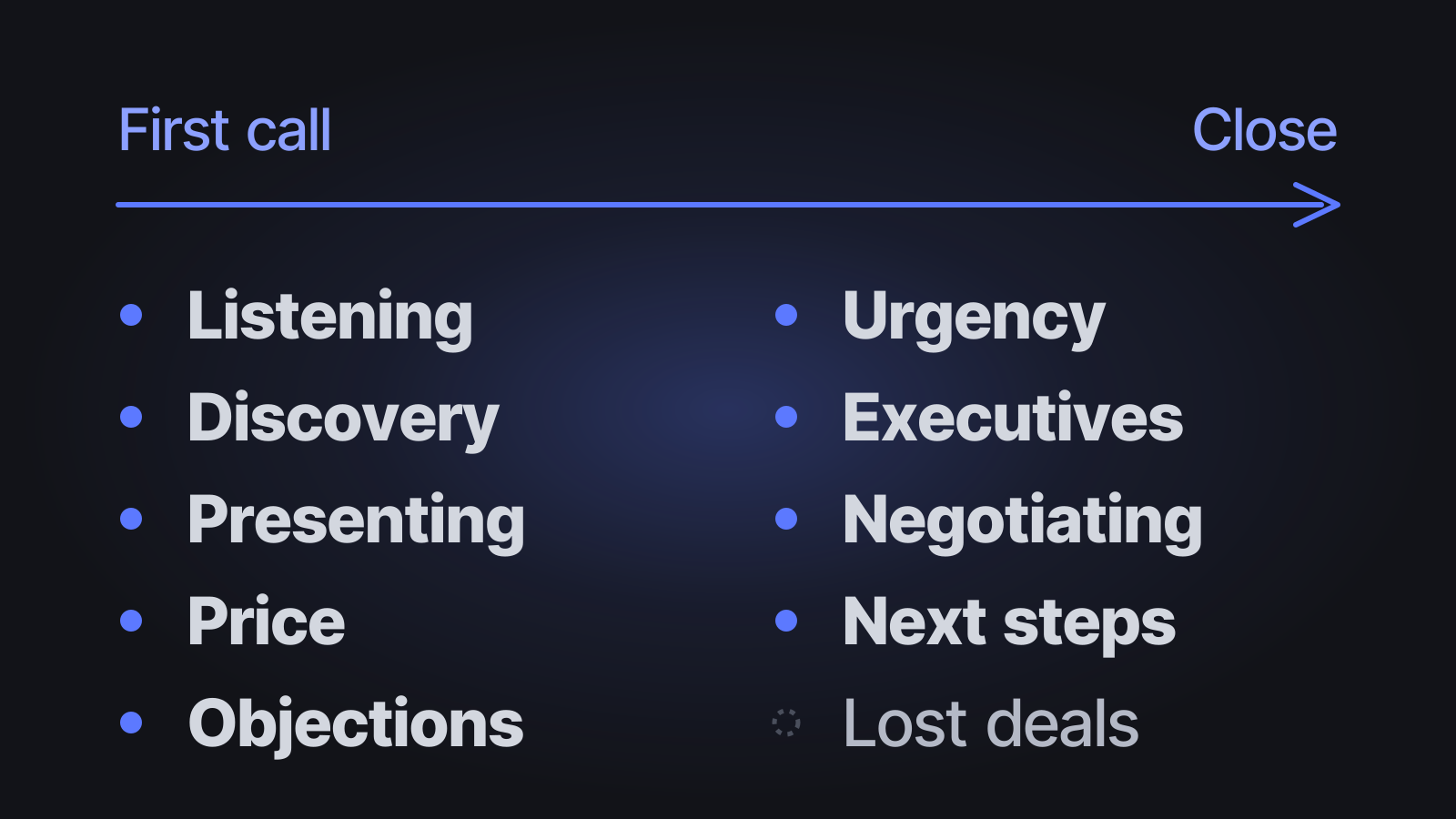
Sales skills are the behaviors a person uses in a deal conversation to find a problem, show what it costs, answer doubt and agree what happens next. Each one can be trained and checked on a recorded call, and this guide covers ten of them: what each is, how to train it, what to listen for and where to go deeper.
It is the map of the sales skills material on this site. Some skills have a post of their own, some have a course or a session, and a few have all three. They come in the order a deal usually asks for them, from the first minutes of listening to the call after a lost deal.
What buyers still want from a seller
Buyers do much of the work before you speak to them. Gartner surveyed 632 B2B buyers in August and September 2024 and described the results in a press release on June 25, 2025. They still turn to sellers for tasks that need judgment, such as deciding whether a product fits their company.
61%
of B2B buyers prefer an overall buying experience without a seller
73%
of B2B buyers actively avoid suppliers who send irrelevant outreach
69%
report inconsistencies between the seller’s website and what sellers tell them
Sample: 632 B2B buyers, surveyed by Gartner in August and September 2024. Read in Gartner’s press release of June 25, 2025, on November 3, 2026. Method: Self-reported survey answers, as summarized in the press release. The full report is for Gartner clients, so the questions and sampling are not public.
Source: Gartner, "Gartner Sales Survey Finds 61% of B2B Buyers Prefer a Rep-Free Buying Experience". Gartner's own advice in the release is that sellers should act as a sounding board and learn what matters most to the buyer at each stage. The ten skills below are how a seller does that. A buyer can find general information alone, so what is left to do on a call is to ask well, notice what the buyer says and help them decide.
The ten skills at a glance
| Skill | What you can hear on a call |
|---|---|
| Listening and rapport | The buyer talks for long stretches, and the seller reuses their words |
| Discovery | The buyer names a problem and what it costs |
| Presenting a solution | Each thing shown ties back to something the buyer said |
| Talking about price | Price comes up after the value is clear, and the seller does not discount first |
| Handling objections | The seller asks a question before answering |
| Creating urgency | The buyer states what waiting will cost them |
| Selling to executives | The call opens on the executive's goal and ends on one ask |
| Negotiating | Every concession is traded for something |
| Setting next steps | The call ends with a date, an owner and an action |
| Winning back lost deals | The outreach names the reason the deal was lost |
Every section has the same three parts: what the skill is, how to train it and how to check it on a call. To check a skill, write it as a question someone could answer from the transcript, which is how the sales call scoring post builds scorecards. "Handled the objection well" gets a different score from every manager. "Asked a question before answering" does not.
1. Listening and rapport
Listening is letting the buyer finish and then asking about what they said, and saving your planned question for later. Rapport is what the buyer feels as a result: this person followed what I said.
Train it with a two-minute drill in pairs. One person describes a real work problem. The other repeats it back in their own words and asks one question about it. Then they switch. The session on the four qualities of active listening walks through the habit, and non-research-based rapport covers building rapport on the spot when there was no time to research the buyer. The Rapport-building tactics course is free and short.
To check it, find the longest stretch where the buyer spoke without being interrupted, and find a follow-up question that uses one of the buyer's own phrases. If you cannot find either, the seller was waiting for a pause.
2. Discovery
Discovery is finding the problem, what it costs and who decides, before you describe anything you sell. It is the skill most other skills depend on, because an objection or a price discussion that comes from a vague problem is hard to resolve later.
Train it by writing the questions down. Most people ask what comes to mind, and most of those questions are about the buyer's situation. The free Discovery best practices course covers the basics, and the session Discovery Call Blueprint gives a 30-minute structure to practice against. For frameworks, the GPCT post and the SPIN Selling post have sample questions.
On a call, check that the buyer stated a problem in their own words, that a cost or consequence was put on it, and that the seller learned who approves the purchase. Gong's analysis of 519,291 sales conversations, published in 2018 and updated on March 4, 2026, found that successful sellers dove deep into three to four problems, and Gong recommends about 11 to 14 questions in total (read November 3, 2026). It is Gong's own data on its own customers, so read it as a direction.
3. Presenting a solution
Presenting a solution is showing the product, a plan or a proposal in terms of the problems the buyer named in discovery. A demo that walks through every feature in menu order is the usual failure.
Train it by rehearsing the first ten minutes of a demo out loud, with a colleague who interrupts the way a buyer would. The free Demo best practices course and Presenting a solution course cover the structure, and the session How to Nail a Sales Demo from Winning by Design makes the case for understanding the buyer's needs before you pitch.
To check it, take each thing the seller showed and ask whether the buyer had said something earlier in the call that it answers. A feature the buyer never asked about is a sign the seller is following a script.
4. Talking about price
This skill is raising price at a point where the buyer has seen the value, and answering questions about it without cutting it first. The usual failures are avoiding the subject until the last call and offering a discount before the buyer has said what they are comparing the price to.
Train it with the sentences themselves. Write down the first thing you say when a buyer asks "how much is it?", and the first thing you say when they answer "that's more than we expected." The sessions 4 Ways to Overcome Price Objections, Neutralising the Price Objection Without Discounting and Quantifying Customer Value give you wording to start from.
On a call, check three things: at what minute price came up, whether value was stated in the buyer's numbers before it, and whether the seller asked a question before offering a discount. Gong analyzed 11,331 opportunities with at least three calls each and reports that win rates were highest when pricing was discussed on the first call, 10% higher, whoever raised it. Its earlier finding was that top sellers bring up price about 38 to 46 minutes into a call (published July 22, 2020, updated March 6, 2026, read November 3, 2026). These are Gong customers and correlations.
5. Handling objections
Handling objections is finding the real concern behind what the buyer says, answering that concern and checking that it is settled. An objection is a sign the buyer is still thinking about the deal.
Train it in a weekly 20-minute drill in pairs, one objection at a time, and keep a log of the ones your team hears. The common sales objections post covers the eight most common ones with a sample exchange for each, and the free Objection handling course teaches a three-step version. The sessions 7 Most Common Sales Objections, The 5 Families of Objections and Conditions vs. Objections go further.
To check it, find the buyer's objection in the transcript and read what the seller did next. Did they ask a question first? How long was the answer? Did they ask whether it settled the concern? In Gong's analysis of 67,149 demo recordings, average sellers answered an objection with a monologue of 21.45 seconds, while successful ones paused longer and asked clarifying questions (page dated March 4, 2026, read November 3, 2026). Gong notes that this is correlation only.
6. Creating urgency
Creating urgency is helping the buyer see what waiting costs them in their own numbers, or what event sets the date. A deadline the seller invented does not count. A deal with no reason to move this quarter tends to wait.
Train it by practicing the cost-of-inaction question: "What happens if nothing changes?" The session Creating Urgency with Cost of Inaction explains why return on investment covers only half of the case, and Two Types of Sales Urgency separates personal from circumstantial reasons. The free Creating urgency course adds exercises.
On a call, check whether the buyer said a date or an event that drives the decision, and whether they stated the cost of waiting in a number or a consequence. If only the seller said it, it was not urgency yet.
7. Selling to executives
Selling to executives is getting a short meeting, opening on the executive's goal, putting the problem's cost in numbers and ending on one specific ask. It also means selling to the group around them. The how to sell to a CEO post covers how to get the meeting, the three numbers to know and eight questions for the call.
Gong analyzed more than one million executive sales cycles with 30 Minutes to President's Club. It reports that a won deal of $50,000 to $250,000 typically involves at least 10 stakeholders, and that win rates drop by roughly 6% when an evaluation starts with an executive, against a 5% rise when executives join around the third touchpoint (published February 13, 2026, updated May 27, 2026, read November 3, 2026). It is Gong's own data, so read it as a direction.
Train it with the Enterprise Account Executive course, which is free, and the sessions 5 Rules for Communicating Effectively with Executives and Sales Questions That Impress Executives. Check it on the call: did the seller open on the executive's goal, put the cost in numbers, and ask for one next step?
8. Negotiating
Negotiating is agreeing terms without giving away the value you built. It starts before the buyer asks for a concession, with knowing what you can trade and what you cannot.
Train it by writing a list before the call: what the buyer could ask for, what you would want in return for each, and where you stop. Then role-play the call with someone who asks for the most expensive thing first. The sessions Intro to Win-Win Customer Negotiations, Top 5 Sales Negotiation Secrets and Sales Negotiations: Secrets of Successful B2B Sales are good starting points. The CS Negotiation Techniques course is written for customer success, and much of it carries over to renewals and expansions.
To check it, list every concession in the transcript and look for what the seller got back. A concession with nothing traded for it is the miss. The pricing and negotiation scorecard in the scoring post turns this into steps.
9. Setting next steps
A next step is a date, an owner and an action, agreed before the call ends. "I'll send something over" is a common way to end a call, and it leaves nothing agreed.
Train it by practicing the last five minutes of calls, because that is where it slips. The sessions How to Set Next Steps That Win Deals, End Every Sales Call with a Next Step and Handling "We'll Get Back to You" cover the wording, and the paid Mutual Action Plans course goes deeper on plans shared with the buyer. Gong's 519,291-conversation analysis found that successful sellers wrap up logistics and next steps at the end of the call (updated March 4, 2026).
To check it, read the last two minutes of the transcript. If there is no date, no name and no action, the step was not set.
10. Winning back lost deals
Winning back a lost deal is reaching out again for the reason the deal was lost, at the time that reason stops being true. A buyer who said "not this quarter" is a different outreach from one who chose a competitor.
Train it by sorting your last 20 lost deals by reason before you write a single email. The closed-lost reactivation post shows how to sort them, when to reach out and a sample email for each reason. The session Reopening Closed Lost Deals and the paid Reopening Closed Lost Opportunities course cover the same ground in video.
To check it, compare the loss reason in your CRM with what the buyer said on the last call. If they differ, the outreach will be aimed at the wrong thing.
How to train a skill so it lasts
Pick one skill per person for a few weeks, practice it out loud and repeat it. A single workshop fades. A 2015 replication of Ebbinghaus's forgetting curve in PLOS ONE got results similar to his original data, with less retained the longer the gap (one subject, nonsense syllables, read November 3, 2026). We found no comparable study of sales training, so treat it as a reason to repeat practice and never as a number to quote.
A routine that works for a team of five to fifteen people: a short workshop on the skill, a pair drill that week, a manager playing the buyer in the next 1:1, and a check of the next five calls for that skill. AI Roleplay can stand in for the buyer when there is no one to play it. The coaching loop, with its weekly rhythm, is in the AI sales coaching guide, and the coaching best practices course is free.
Which skill to train first
Train the one your own calls miss most often. If calls are scored, read the steps with the lowest rate of "met" on one call type and start there. If they are not, listen to ten calls and tally how many end with a dated next step, how many had a problem the buyer put a cost on and how many objections were answered with a question. The lowest of those three is your first skill.
For sales managers
A manager's own skills are the ones above, used to teach: choosing the one skill to coach, finding the call moment that shows it and running the practice. The sales call scoring post has the scorecard templates and a calibration agenda, and you can see how many of your calls a manager can actually hear with the call scoring calculator.
FAQ
What are the most common sales objections and how do you handle them?
The most common are price, timing, "send me some information", an existing competitor, no authority, no need, status quo and trust. The first move is the same for all of them: ask a question to find the real concern before you answer. The common sales objections post has what to say for each one.
How can I coach or motivate my people to improve?
Pick one skill, show the person a moment from their own call where it was missed, agree the words to try and practice them once or twice. Then check the next calls for that one skill. Working on one skill at a time is easier to see and easier to repeat than a general talk about doing better.
How do you practice sales skills?
Say the skill out loud against someone who plays the buyer, then repeat it a few days later. Reading about a skill does not count as practice. Pairs, a manager playing the buyer and AI roleplay all work, as long as the person is scored on the same step they will face on a real call.
What discovery questions should every salesperson ask?
Ask about the buyer's goal, the problem in the way, what it costs and who decides. There is no list that fits every team, so write yours from the problems your buyers actually have. The GPCT and SPIN posts have sample questions for each part of a discovery call.
How do you run a discovery call?
Open with the buyer's situation and goal, spend most of the time on a few problems and what each one costs, find out who decides, and end by agreeing a dated next step. Gong's analysis of 519,291 sales conversations found that successful sellers dive deep into three to four problems (page updated March 4, 2026).