
AI sales coaching is software that scores your recorded sales calls against your own playbook, shows each person which step they missed and where in the call it happened, and gives them a way to practice it before the next one. It is for sales managers and enablement leads whose team makes more calls than anyone can listen to.
This guide defines the category and walks through the coaching loop. It covers how often to coach, how to score a call, how to check that behavior changed, a 30-day rollout and where it breaks. Each part links to a post, course or session that goes deeper.
What AI sales coaching is
AI sales coaching has five parts: the call is captured, scored step by step against a scorecard your team wrote, coached on the one step that was missed, practiced before the next real call, and checked again on later calls. A tool that skips one of them leaves that work to a person.
The first two parts are what most people picture. The last three decide whether anything improves. A score nobody discusses is a report, and a call nobody practices after feedback usually repeats the same miss. The next sections take each part in turn.
The manager keeps the judgment calls: which step to work on this week, how to run the 1:1, what a deliberate choice on a call looks like and how the team's trust is kept. AI sales coaching vs traditional coaching covers that split in detail, so this guide does not repeat it.
What it costs depends on the vendor, and most tools charge per user per month. For reference, Triple Session lists AI Coach at $55 per user a month, billed annually, with a one-time onboarding fee (the pricing page, read November 3, 2026).
How it differs from recording calls
A recording tool gives you the call and a transcript. AI sales coaching adds a verdict on the call, step by step, and a next action for the person on it.
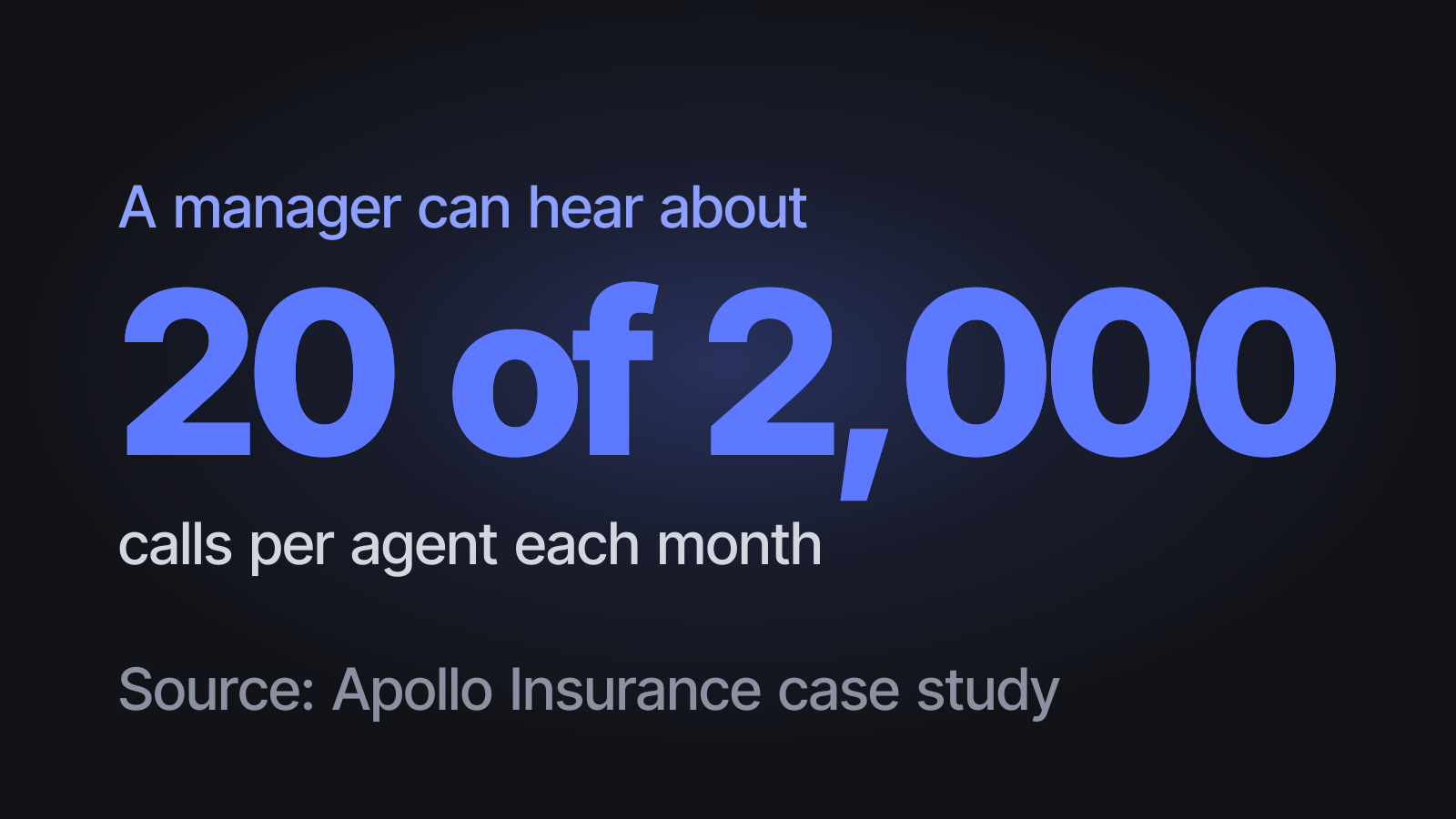
The difference shows up in coverage. Apollo Insurance, whose agents make about 100 calls a day, says in its case study that a manager might hear about 20 of one agent's roughly 2,000 monthly calls all the way through (read November 3, 2026). That is about 1%. A library of recordings does not change that number, because someone still has to listen.
| Recording and notes | AI sales coaching | |
|---|---|---|
| What you get per call | A recording, a transcript and often a summary | A score on each step of your scorecard, with the moment that earned it |
| Who defines "good" | Nobody, or a generic template | Your team, in the scorecard |
| What happens after the call | A manager has to find the call and listen | The person sees the missed step soon after the call ends |
| Coverage | The calls a manager has time to open | Every call that was captured |
| Practice | Outside the tool | Tied to the step that was missed |
| Proof of change | A manager's memory | The same step scored again on later calls |
Conversation analytics sits in between. It adds counts, such as talk time and how often a topic came up. Counts show what was said. A scorecard shows whether the call did its job, and that is the part a manager coaches.
How it works in practice
Here is the loop in the language of the product, with a discovery call from Priya, a fictional seller at Corvane, as the example.
Capture
Calls come in through a meeting bot that can carry your company's name and logo, or through the recording tools you already use, such as Zoom, Meet, Teams or a phone system like Aircall. The goal is every call, not a sample.
Score
Your playbook becomes a scorecard for each call type. In Triple Session, specialists build the first version with you, and every call then comes back scored step by step, with the feedback behind each score. On the Corvane call, "Quantified the cost of inaction" is scored as missed. The buyer said two of five new hires missed quota last quarter, and the seller moved on to a demo without asking what that cost. The score links to that moment in the recording.
Coach
The person sees the missed step and the moment. The AI Coach recommends the sessions, roleplays and call examples for that skill, and the manager picks the one step to bring to the next 1:1. The Coaching & Enablement page shows what this looks like in the product.
Practice
The seller rehearses the moment before it happens again. AI Roleplay lets them do that out loud against a buyer persona built from your own customer profile, and the practice is scored on the same scorecard as real calls. The AI Roleplay page has the details.
Verify
Later calls show whether the step moved, for each person and for the team. If it did, move to the next step. If it did not, the scorecard, the coaching or the practice needs a change. That check is the easiest to skip, and it gets its own section below.
How often to coach
Coach each person once a week on one step, and look at the team's pattern once a month. That is our recommendation. The public data points the same way, though it is thin and mostly from vendors.
64%
of organizations coach fewer than half their people every week
54%
of organizations that coach 76% to 100% of their people weekly report 71%+ quota attainment
25%
of organizations that coach fewer than a quarter of their people weekly report the same
Sample: 312 sales managers, directors, VPs and CROs, surveyed by Ambition in summer 2026. Read November 3, 2026. Method: Self-reported by sales leaders, and Ambition sells coaching software. The page does not define 71%+ quota attainment, and the result is a correlation, not a cause.
Source: Ambition, "Your managers say they're coaching", September 2026. Ambition reads its own result as coverage mattering more than frequency: how many people get coached counts for more than how often one person does. For a manager, that argues for a short weekly 1:1 with everyone over a long one with a few.
Here is a rhythm that holds up with a team of five to fifteen people. It is a starting point, not a study.
| When | What happens | Time |
|---|---|---|
| After every call | The score and feedback reach the seller, with no manager time | None |
| Weekly, each person | Coaching 1:1 on one step | 20 to 30 minutes |
| Weekly, each person | One practice round on the same step | About 10 minutes |
| Monthly, managers | Everyone scores the same call alone, then compares | 45 minutes |
| Monthly, team | A short session when most people missed the same step | 20 to 30 minutes |
The monthly calibration is what keeps scores fair between managers. The call scoring post has a 45-minute agenda you can run as written.
What to do in each conversation
Keep every coaching 1:1 to one step. This order works:
- Ask which call from this week they would replay, and why. People often pick the moment you planned to play.
- Play 30 seconds of a call where the step was missed, and ask what was happening there.
- Agree on the exact words to try next time.
- Practice them once or twice, with you as the buyer.
- Pick the calls where they will try it, and the day you will check.
The full agenda, with times, is in the weekly routine in the AI vs traditional coaching post. For the skills behind it, there is a free coaching course, and sessions on running a sales coaching session, coaching and 1:1s and coaching by asking questions.
How to score a call
A scorecard is a short list of questions about a call, each one answerable from what was said. Four steps get you a version you can use.
- Pick one call type. Discovery, cold call, demo or pricing. A scorecard that tries to cover all four gets vague.
- Write four to eight steps as questions. "Did they find out who signs off on the purchase?" can be answered by listening. "Built rapport" cannot.
- Say what met, partial and missed look like. One line each. Without them, two managers will score the same call differently.
- Calibrate. Have a second manager score five of the same calls without seeing your marks, and rewrite every step where you disagree.
Here is a discovery scorecard of four steps. The wording is an example, so change it to match your playbook.
| Step | Met when | Missed when |
|---|---|---|
| Found the problem | The buyer states a problem in their own words | The seller moves to a pitch before a problem is named |
| Put a cost on it | The buyer gives a number or a consequence | The problem is named and never priced |
| Learned who signs | The seller gets a name or a title for the person who approves the purchase | The answer is "my boss" and the seller moves on |
| Booked a dated next step | A date and an owner are agreed before the call ends | The call ends on "I'll send something over" |
The sales call scoring post has templates for discovery, cold calls, demos and pricing calls, and the full calibration agenda. To see how much of your own calling is scored today, use the call scoring calculator. The session on AI scorecards and deal insights shows why the wording of each step matters when software does the scoring.
If you use AI to score, the same rules hold, and the check gets more important. The software applies your wording to every call, including the unclear steps, so read its scores against your own on a handful of calls before you coach from them.
How to measure whether behavior changed
Coaching has worked when the step you coached shows up more often in later calls. Four things make that visible.
- Set a baseline. Before you coach a step, count how often it was met in that person's last several calls of the same type. Say Priya met "Put a cost on it" on 2 of her last 10 discovery calls. That is the number to move.
- Change one thing. Coach one step, practice it and leave the rest of the scorecard alone for a few weeks.
- Score the next calls on that step. Compare the same call type, and wait for enough calls for the rate to mean something. With only two or three calls, one bad day moves the number.
- Follow the outcome the step is meant to move. A step is a bet that doing it more often changes a result, such as next steps booked, stage conversion or referrals. Give deal outcomes a full sales cycle before you judge them.
Look at the team too. If most people miss the same step, the fix is training or a clearer playbook, and individual 1:1s will not get you there.
Apollo Insurance published one example of the full chain. It made the referral ask a scored behavior on every call, and reports what followed.
+72%
client referrals after the referral ask became a scored behavior
+50%
close rate on those referral leads
20 of 2,000
monthly calls per agent a manager could hear before
Sample: One customer, Apollo Insurance, as published in its case study. The page gives no period for the referral and close rate figures. Read November 3, 2026. Method: Figures reported by the customer, which says it traced both gains to the new referral ask in its scorecards. Not an independent audit, and one company is one company.
Source: the Apollo Insurance case study. The same step, scored on every call, is what made the change visible. A team that hears 1% of its calls cannot see a behavior move.
A 30-day rollout
You can start without buying anything. Run weeks one and two by hand, then decide what you need. If you choose a tool, Triple Session's pricing page says its onboarding gets a team coaching on live calls in two to four weeks (read November 3, 2026), and it is a fair benchmark to hold other vendors to.
| Week | What to do | Done when |
|---|---|---|
| 1 | Pick one call type and four steps. Write the met, partial and missed lines. | Two managers read the scorecard and agree what each step means |
| 2 | Get calls recorded, score ten of them, and calibrate with a second manager | Your scores and theirs agree on most steps, and the rest are rewritten |
| 3 | Show each person their own scores first, then run the first coaching 1:1s, one step each | Everyone has one step and a day it will be checked |
| 4 | Score the next calls on each person's step, and fix any step that was unclear | You know which steps moved, which did not and why |
Two things make week three go well. Tell the team before the first score arrives what the scores are for, which is choosing what to coach and never ranking people. And let sellers see their own results, because coaching lands better when nobody is surprised by it.
If you want to try scoring before you commit, Coach every call has six free AI agents you can load into ChatGPT, Claude or Gemini to score calls and prepare 1:1s. They work on a handful of calls at a time, which is enough to test your scorecard.
Where it fails
Most failures come from the same few places, with or without software.
The scorecard is vague
"Handled objections well" gets a different score from every manager, and from the software too. Rewrite each step as a question that a person who was not on the call could answer from the transcript.
Nobody has the conversation
Scores that go into a dashboard and never reach a 1:1 teach people to ignore them. If a score feeds no 1:1, practice round or team session, stop collecting it.
Scores become a ranking
When a number decides who looks good in the Monday meeting or what someone earns, people work on the number. They ask "Who signs off?" in the last minute and move on. Keep scores for choosing what to coach.
The audio is bad
A noisy line, heavy cross-talk or a poor transcript produces confident scores on a call that was never heard properly. Spot check low scores against the recording, and fix the audio problem before you coach on the result.
People feel watched
Recording and scoring land badly when they arrive as surveillance. Tell people what is recorded and why, let them see their own scores, and check the recording and consent rules for the places you call.
It misses what only a person hears
Software scores what was said. It does not know that the buyer was about to leave the company, that the seller dropped a step on purpose, or that the deal was already lost. Those calls stay with the manager.
Practice stays optional
Hearing a miss does not fix it. Without a short practice round before the next call, most people repeat the habit under pressure.
The tool was never tested on your calls
A demo on the vendor's sample call tells you little. Bring one call you scored as strong and one you scored as weak, and see whether the tool agrees with you and shows the moment behind each score. The AI vs traditional coaching post has a list of questions to ask any vendor.
FAQ
What is AI sales coaching?
AI sales coaching is software that scores recorded sales calls against your own playbook, shows each person the step they missed and the moment it happened, and gives them practice before the next call. The manager still chooses what to coach and runs the 1:1.
How does AI sales coaching work?
It runs a loop of five steps: capture the call, score it step by step against a scorecard, coach the person on one missed step, let them practice that step, and check later calls to see whether it changed.
Does AI sales coaching work?
It works when the scorecard is specific and a manager acts on the results. Public evidence is thin and comes mostly from vendors. In a 2026 Ambition survey of 312 sales leaders, 54% of organizations that coach 76% to 100% of their people weekly report 71%+ quota attainment, against 25% of those that coach fewer than a quarter (self-reported, correlation only, read November 3, 2026). Test any tool on your own calls before you rely on it.
Does an AI sales coach replace a human sales manager?
No. The software scores calls and finds patterns across them. The manager picks the step to coach, runs the 1:1, judges the edge cases and keeps the team's trust.
How often should a sales manager coach their people?
A workable rhythm is one 20 to 30 minute coaching 1:1 per person each week on a single step, a monthly calibration of the scorecard, and a team session when most people miss the same step. This is our recommendation. The survey data in this guide is consistent with it but does not prove a number of hours.
What should a sales manager do in a 1:1 with a salesperson?
Ask for their read of a recent call, play 30 seconds of a call where one step was missed, agree the words to try, practice them once or twice, and set the date you will check. Keep it to one step per 1:1.
What is a sales call scorecard and how do I make my own?
A scorecard is a short list of steps a call should hit, each written as a question you can answer from what was said, with a line for what met, partial and missed look like. Pick one call type, write four to eight steps, and score five calls with a second manager to check that you agree.
What is the difference between sales training and sales coaching?
Training teaches a skill to many people at once, usually away from live work. Coaching works on one behavior in one person's real calls, with evidence from those calls. Most teams need both.
How much does AI sales coaching cost?
Most tools charge per user per month. Triple Session lists AI Coach at $55 per user a month, billed annually, with a one-time onboarding fee (pricing page, read November 3, 2026). When you compare vendors, ask whether there is a platform fee on top of the per-user price.