
Triple Session wins against the nine tools in this guide on three things you can check on public pages: it publishes its price and charges no platform fee, its $55 plan scores every call on your own scorecard and writes a coaching plan for each person, and it is the only one of the ten that publishes a price for a plan with call scoring and AI roleplay together. It fits sales teams that want to coach every call. It loses to other tools when you need forecasting, outbound sequences, a free trial or notes alone.
I work at Triple Session, so this guide argues for it, and a section near the end says where it loses. Every competitor fact links to the page I read on November 3, 2026, and where two sources disagree I show both. "Not found" means the pages I read do not mention it, so the product may still have it. For a neutral side-by-side of ten tools, see the AI sales coaching software comparison. This guide asks one question about each tool: what does Triple Session win against it?
6 of 9
competitors publish no per-user price for any paid plan
1 of 10
publishes a price for a plan with real-call scoring and AI roleplay
$40
per user a month is what AI roleplay adds on Triple Session ($95 against $55)
Sample: Triple Session and nine competitors: Gong, Chorus, Avoma, Fathom, Fireflies, Hyperbound, Second Nature, Allego and Mindtickle. Pricing, product and help pages read November 3, 2026. Method: Counted from what each vendor’s own pages state. "No price" means no per-user amount for any paid plan on the vendor’s site. Roleplay and scoring are counted only where a page says so. $40 is $95 minus $55 on the Triple Session pricing page.
What conversation intelligence software covers
Conversation intelligence software records sales calls, transcribes them and analyzes what was said. Gong's FAQ says it records and transcribes customer conversations, emails and meetings, and ZoomInfo's conversation intelligence page says Chorus captures and analyzes every sales conversation. That gives a manager a library to search and, in most tools, a score.
What happens next is where the tools differ. A score can end in a dashboard, or it can send a person to a coaching task, a practice round and a later call scored on the same step. The sections below compare the nine tools on that second part, and on what you pay to get it. The loop itself is laid out in the AI sales coaching guide.
Why Triple Session is built differently
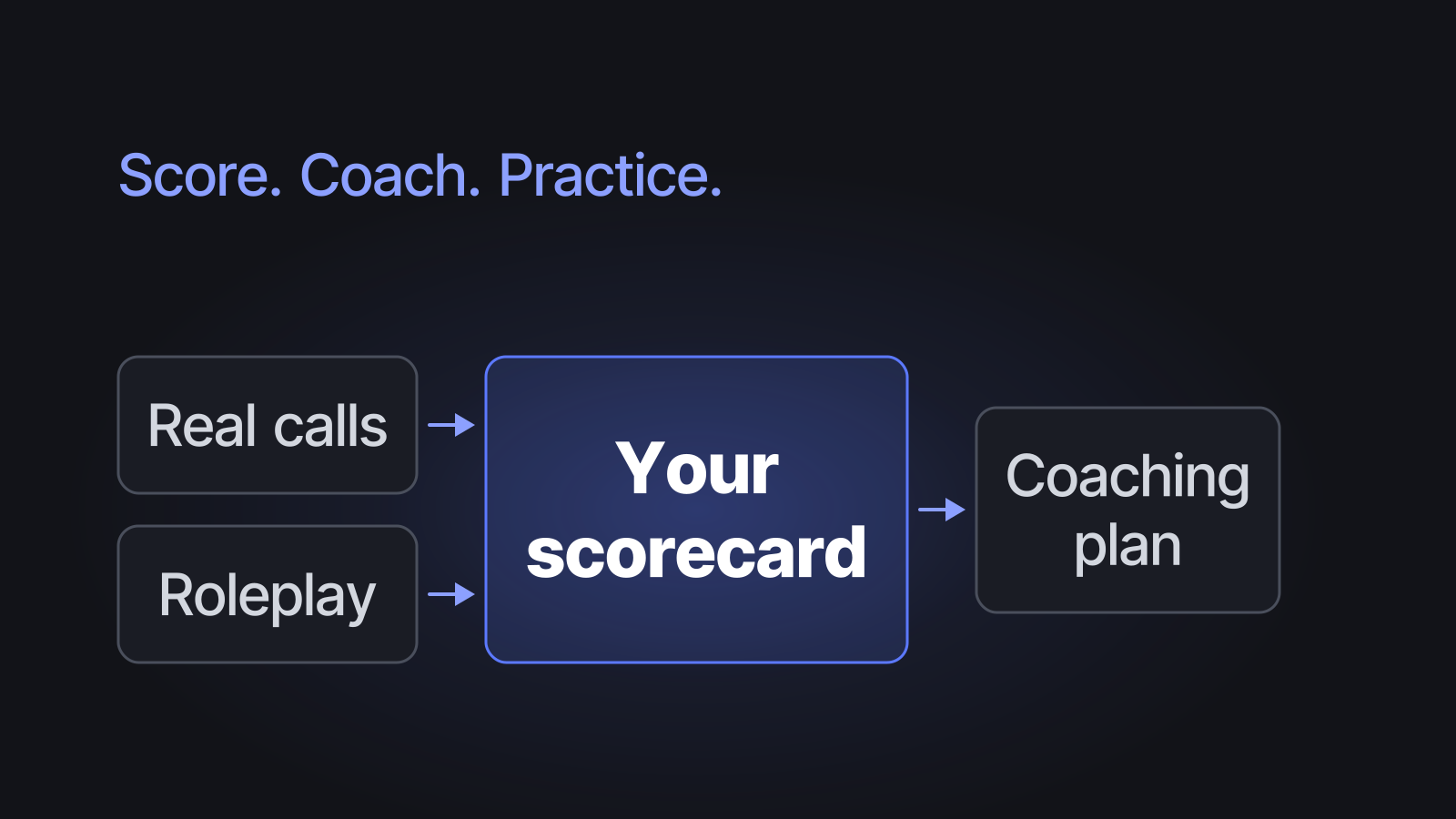
Triple Session is built around one loop on one scorecard. The scorecard comes from your own sales process, and Triple Session's specialists build the first version with you during onboarding. Real calls are scored against it, and so are roleplays: the roleplay page says every roleplay is scored on the same scorecards as your calls. When someone scores low on a skill in a real call, the AI Coach puts the matching roleplay in that person's coaching plan, next to the session that teaches it, with a due date.
The price is on the pricing page, billed annually, and the page says there is no platform fee. Here is what each plan holds.
| Plan | Price | What it includes |
|---|---|---|
| Academy Pro | $45 | Every free and Pro course, team course builder, team training analytics, leaderboard, email support |
| AI Coach | $55 | Call scoring on your own playbook, recording bot and call imports, Moments, Pulse, Ask AI Coach and Global Insights, Automations and CRM Auto-Update, REST API, free courses, email support |
| Academy Pro + AI Coach | $95 | Everything in both plans, plus AI Roleplay and Slack support |
| Enterprise | Custom | Everything above, plus single sign-on, your own training content, a dedicated account manager, live workshops and priority support |
| Onboarding | $3,000 or $5,000 | Standard: scorecards, AI calibration, automations, CRM mapping and manager training. Advanced adds roleplay setup. The page says coaching on live calls starts in 2 to 4 weeks |
Sample: The Triple Session pricing page, read November 3, 2026. Method: Prices are per user a month, billed annually. Onboarding is a one-time fee. The $100 is the two plans bought separately, as the page shows it.
The recording bot joins the meetings you choose, and calls can also be imported from Zoom, Google Meet, Microsoft Teams, HubSpot, Aircall and Kixie. CRM Auto-Update syncs both ways with HubSpot and Salesforce. The call scoring page describes scorecards by call type with weighted steps. These are claims from Triple Session's own site, and the rest of this guide holds the competitors to the same standard: what their own pages say.
Each of the next nine sections gives the price and what the plan holds, what the vendor's pages say and do not show, where Triple Session wins, and when the other tool is the better buy.
Gong
Gong sells a core license plus applications, each with its own seats. Its plans and seats article (updated January 8, 2026) lists Enable Essentials for AI coaching, Forecast Essentials, Gong Forecast, Gong Engage and Data Cloud as additions to the core license. Its help pages say AI scoring is available on Enable Essentials and Enable (scoring, updated September 13, 2026) and that the AI Trainer roleplay agent is available on Enable (AI Trainer, updated April 13, 2026). So the scoring and practice that one Triple Session plan holds sit at Gong in a second set of seats on top of the core license.
Gong's pricing page says licenses are priced per user, that there is a platform fee based on the number of users supported, and that you should fill in a form for a proposal. It shows no amounts. Vendr reports a median of $55,430 a year across 1,152 purchases, in a range of $11,537 to $204,608 (page last updated March 2026). The page disagrees with itself: its header shows an average of $55,429 over 593 deals, and the Gong pricing post quotes $55,359 from an earlier read of the same page, so treat the figure as about $55,000. For small teams Vendr says $1,600 to $2,400 per seat a year, which for 20 seats is $32,000 to $48,000 before the platform fee. The Gong pricing post works through the rest.
Triple Session wins here on three points:
- A price against a form. Triple Session prints $45, $55 and $95 and says no platform fee. Gong prints no amount and says it charges a platform fee.
- Plan boundaries you can read. At Triple Session, scoring is in the $55 plan and roleplay is the $40 step up. At Gong you need a quote that names the core license and the Enable seats, and Forecast and Engage if you want them.
- A stated start. The Triple Session pricing page says coaching on live calls starts in 2 to 4 weeks. I found no onboarding timeline on the Gong pages I read, so ask for one in writing.
HubSpot and Salesforce are a tie: Gong's help center lists both on any plan (HubSpot, Salesforce).
Choose Gong when you need forecasting or outbound sequences in the same platform as your call recordings and can sign a contract that large. Gong also says it has 300+ integrations in its Collective (Gong), and its press page says it was named a Leader in the 2026 Gartner Magic Quadrant for Revenue Action Orchestration on October 16, 2026. A June 24, 2026 release announced an AI Coach conversation after each AI Trainer session and Dry Run rehearsals from a calendar invite, with Dry Run expected in July (Gong release), so its practice offer is current. The feature-by-feature view is on Triple Session vs Gong, and the switch is covered in Gong alternatives.
Chorus
Chorus is ZoomInfo's conversation intelligence product. ZoomInfo's Chorus page says it captures and analyzes customer calls, meetings and emails, and its buttons all say Request Demo. The page, which I read in a browser because it blocks automated readers, also lists deal intelligence and forecasting. It shows no price, no scorecard and no roleplay, and a scorecard appears only inside a customer review. ZoomInfo's pricing page lists its Sales plans (Professional, Copilot Advanced and Copilot Enterprise) without naming Chorus, and Chorus shows "Learn More" with no amount.
For scoring and coaching I used ZoomInfo's blog. Its Gong vs Chorus comparison (it prints "Updated on 06/12/2026") says Chorus has scorecards that managers fill in to rate people, Smart Playlists, peer review and self-coaching. It says neither Gong nor Chorus publishes prices, that Chorus can be bought alone or inside a larger ZoomInfo subscription, and that product innovation has reportedly slowed since ZoomInfo bought Chorus in July 2021. The same post gives automatic AI scoring to Gong, and I found no AI scoring and no roleplay for Chorus on the pages I read. ZoomInfo's Chorus integrations guide (a PDF last modified July 29, 2026) lists Salesforce, HubSpot and Microsoft Dynamics, cloud versions only, and says Salesforce must be on the Enterprise, Unlimited or Developer edition.
Triple Session wins here on three points:
- Scoring that needs no manager. Triple Session scores every call by AI on your scorecard. The Chorus pages I read describe scorecards that a manager completes.
- Practice. AI Roleplay is in the $95 plan. I found nothing like it for Chorus.
- Price. Triple Session lists amounts. Chorus has none, and what you pay can depend on a ZoomInfo bundle.
Choose Chorus when you already buy from ZoomInfo and want call recording and deal intelligence inside that contract, or when your managers prefer to score by hand and run training from playlists. The longer comparison is on Triple Session vs Chorus.
Avoma
Avoma charges per recorder seat a month, billed annually: Startup $19 (up to 25 paid seats), Organization $29 (up to 100) and Enterprise $39 (minimum 10), with free seats for people who only watch recordings (Avoma pricing). AI call scoring and coaching scorecards sit in the Conversation Intelligence add-on, $29 per seat a month billed annually, so scoring on Startup costs $48 a seat. The page lists no setup fee and no minimum platform fee, offers optional onboarding with an Avoma specialist at $1,000 one time, and gives a 14-day trial of Organization with every add-on and no card. The page shows more than one monthly price for Organization ($24 and $39), so I use annual prices only.
Avoma's scoring page says it scores 100% of sales calls against your scorecards, with templates for MEDDIC, MEDDPICC, BANT, SPICED and Sandler. Its coaching page says managers get a weekly digest with examples from recent calls and the areas to improve for each person. The same page says "Some tools also include AI practice sessions" without saying Avoma does, and I found no roleplay on any Avoma page I read. Vendr reports a median of $23,112 a year (range $12,471 to $35,154, last updated February 2026), but describes Starter, Plus and Business plans at $49 to $79 or more, which do not match the plan names or prices on Avoma's own page. For a list price I trust the vendor's page.
Triple Session wins here on two points:
- Practice. AI Roleplay is in the $95 plan and is scored on the same scorecard as real calls. With Avoma, practice is a second tool.
- Coaching that reaches the person. Avoma's digest goes to managers. Triple Session's AI Coach builds a coaching plan for each person, with sessions and roleplays and a due date.
Avoma is cheaper for scoring and coaching: $48 against $55 a seat, which is $1,680 a year less for 20 people before Triple Session's one-time $3,000 onboarding. Viewers are free, there is a trial, and it records other kinds of meetings too. Choose Avoma when practice is not part of the job and price or a trial decides it.
Fathom
Fathom's pricing page lists a free plan with unlimited recordings and transcriptions, Team at $15 and Business at $25 per user a month billed annually (two users minimum each), an individual Premium plan at $16, and Enterprise through sales. It offers a 90-day guarantee. Business lists coaching metrics, AI scorecards, CRM field sync and Deal View, and its feature table limits CRM syncs to "Max 3 users/ domain" on some plans. Two sources disagree on scorecards: Fathom's comparison with Gong says scorecards come on every plan "from free upward", while the pricing page puts AI scorecards under Business. I use the pricing page.
On September 14, 2026 Fathom announced it is now part of Superhuman and said nothing changes today for its users (Fathom). I searched Fathom's pricing page, sales page and Gong comparison for roleplay and found none. Its coaching features are speaking-pattern metrics and scorecards that help managers coach, and I found no coaching plan for a person. Vendr's page for Fathom reports a median of $7,586 a year (range $1,548 to $13,920, no update date) and says Team starts around $19 to $29, which does not match Fathom's own $15 and $19.
Triple Session wins here on two points:
- A plan for each person. A low score on a real call puts a matching session and roleplay in that person's plan with a due date. On Fathom I found metrics and scorecards for managers to act on.
- Practice on the same scorecard, in the $95 plan.
Fathom costs less than half as much at $25 against $55, has a free plan, and offers bot-free capture in beta. Choose Fathom when your managers already coach well and need notes and scorecards. The long form is on Triple Session vs Fathom.
Fireflies
Fireflies' pricing page lists Free, Pro at $10, Business at $19 and Enterprise at $39 (annual only) per seat a month billed annually, with AI credits that rise from 20 on Free and Pro to 30 on Business and 50 on Enterprise. For more than 50 members it asks you to contact sales. The pricing page does not mention scorecards. Fireflies' sales page says each call can be scored against BANT, MEDDIC and SPICED, and its help guide lists scorecards under "AI Skills for Sales" in the Business package. A press release copy dates the AI Sales Suite to July 22, 2026. To learn what the $19 plan scores, you read four pages.
Coaching on Fireflies is mostly measures: its conversation intelligence page says admins can see questions asked, talk time and monologues per person and coach from them. I found no coaching plan, no coaching dashboard and no roleplay on the pages I read.
Triple Session wins here on two points:
- One page that says what you get. Scoring, Moments, Pulse and CRM Auto-Update are listed on the $55 plan, and roleplay on the $95 plan.
- A coaching plan and roleplay, which I found no sign of at Fireflies.
Fireflies is far cheaper at $19, with a free plan. Choose it for notes, summaries and light scoring on a small team.
Hyperbound
Hyperbound's pricing page shows three plans. Free has 45 prebuilt AI roleplays and example scorecards. Practice adds roleplays with custom AI scorecards and custom AI coaching. Perform is "everything in Practice" plus real-call scoring, post-call review, call summaries and deal coaching, and its table marks CRM sync for HubSpot, Salesforce and Dynamics as included in Perform only. Hyperbound says it is priced per user with separate licenses for Practice and Perform and offers volume and multi-year discounts, but the page shows no amount for Practice or Perform. Vendr reports a median of $12,000 a year (range $11,680 to $30,624), for one product without saying which plan, on a page titled 2025.
Hyperbound's release of September 14, 2026 says Gartner named it an example vendor in its 2026 market overview of B2B sales AI role-play applications.
Triple Session wins here on two points:
- Real calls and practice in one price list. The $55 plan scores real calls and syncs HubSpot and Salesforce, and the $95 plan adds roleplay. At Hyperbound, real-call scoring and CRM sync are in Perform, and no plan has an amount.
- Amounts before a demo. Hyperbound's paid plans lead to a booked call.
Hyperbound's Perform plan also routes real calls to practice (its table lists "AI Coach (Calls → Practice)"), so on that point the two are alike.
Choose Hyperbound when practice is the main gap and scoring real calls can wait. Its free plan lets you try 45 roleplays before you talk to sales, which Triple Session cannot match, since it has no free trial.
Second Nature
Second Nature sells AI roleplay. Its FAQ lists live conversations, webcam-based pitch recordings, slide-based presentations and product demos with screen sharing. It says AI scores each session on knowledge and on style, such as pace and filler words, and that managers can add scoring on the same rubric or a custom scorecard. Dashboards show progress, completion and proficiency by team, and the FAQ lists SCORM, SCIM and SAML SSO. It also lists HubSpot and Salesforce. The FAQ says "more than 25 languages", while the product page says 30+, so the site disagrees with itself.
The site has no pricing page (the /pricing address returns a 404), and its enterprise page sends you to a demo. Vendr reports a median of $19,000 a year (range $19,000 to $26,700, no update date). I found no recording or scoring of real calls on the pages I read. Its home page mentions a Deal Coach for live deals and has no page for it.
Triple Session wins here on three points:
- Real calls and roleplay on one scorecard. Triple Session scores both, and the scores from real calls decide which roleplay a person is assigned.
- Recording and scoring of real calls. The $55 plan has a recording bot and call imports, and I found none on Second Nature's pages.
- A price you can read before a demo.
Second Nature does more with practice: video avatars, slides, demos and 25 or more languages, against five languages in Triple Session's roleplay (English, Portuguese, Spanish, French and German). Its September 30, 2026 post says it was named a G2 Leader in AI sales roleplay and cites 200+ enterprise customers, both its own claims. Choose Second Nature when practice is the program and you need LMS connections or many languages.
Allego
Allego calls itself a revenue enablement platform with learning, content, coaching and digital selling (Allego). Its conversation intelligence page says it records, transcribes and summarizes conversations and scores calls against standardized rubrics. Its coaching page (dated October 28, 2026) describes AI roleplay with avatars in 32 languages and 71 voices, scoring in 59 languages and skills dashboards by person, team, role and region.
Allego's pricing page says it prices per user per month, billed annually upfront, depending on seats and contract length. It says its typical contract is three years, that AI and support carry no extra charge and that managed services cost extra. It shows no amounts. Vendr reports a median of $49,600 a year (range $28,470 to $110,594, no update date).
Triple Session wins here on two points:
- A price list. Allego asks for a quote. Triple Session prints the amounts and bills annually.
- A shorter term to compare. Allego says its typical contract is three years paid annually, and I found no multi-year term on Triple Session's pricing page.
Allego does more than coaching: content, learning and digital selling in one platform, with 120+ integrations listed on its integrations page. Its October 21, 2026 release says Forrester named it a Leader in its Q4 2026 Revenue Enablement Platforms Wave. Choose Allego when an enablement team runs content, learning and coaching as a program and can commit for several years.
Mindtickle
Mindtickle is a revenue enablement platform. On April 21, 2026 it launched ElevateOS, which it calls an agentic operating system for revenue enablement (Mindtickle). Its conversation intelligence page covers recording, AI scoring against behaviors such as talk time and pace, and coaching forms for manual coaching. Its AI role play page says people can practice in 25+ languages and that role plays draw on signals from your team's customer calls. It says there is no self-serve free version and points to a free demo.
The site has no pricing page: /pricing redirects to the platform page. Vendr reports a median of $44,356 a year across 65 purchases (range $11,157 to $138,726, last updated February 2026), and its text puts a 10 to 50 user contract at $50,000 to $150,000, above the median and past the top of its own range. On CRM, Mindtickle has a Salesforce page. HubSpot appears only in the structured data of its integrations page, and the conversation intelligence page names Salesforce and Microsoft Dynamics. I could not confirm HubSpot from the visible text.
Triple Session wins here on two points:
- A price you can read. Mindtickle shows none.
- HubSpot, confirmed. Triple Session's CRM Auto-Update page names HubSpot and Salesforce and describes the sync as two-way.
Choose Mindtickle when you run an enablement program, want coaching forms, hybrid coaching formats and readiness content in the same place, and can buy through a sales process. Its home page says Gartner named it a Leader in the 2026 Magic Quadrant for Revenue Enablement Platforms, for the second year.
The nine in one table
| Tool | What Triple Session wins | When the tool is the better buy |
|---|---|---|
| Gong | A published price, no platform fee, scoring and roleplay in one price list | You need forecasting and outbound sequences, or 300+ integrations |
| Chorus | AI scoring, roleplay and a price list | You already buy ZoomInfo and score by hand |
| Avoma | Roleplay, and a coaching plan for each person | You want the lower seat price, free viewers and a trial |
| Fathom | A coaching plan for each person, and roleplay | You need notes and scorecards at $25, or free |
| Fireflies | A priced plan that lists scoring, a coaching plan and roleplay | You need notes and light scoring at $19, or free |
| Hyperbound | Real-call scoring, CRM sync and roleplay with amounts on the page | Practice is the gap and you want 45 free roleplays first |
| Second Nature | Real calls, recording and CRM Auto-Update next to roleplay, and a price | Practice is the program and you need many languages or an LMS |
| Allego | A price list and a yearly bill against a typical three-year term | An enablement team runs content, learning and coaching |
| Mindtickle | A price you can read, and HubSpot confirmed on a feature page | An enablement program with coaching forms and readiness content |
Sample: Nine competitors, product, pricing and help pages read November 3, 2026. Method: Each cell restates a finding from the section above. "Not found" means the pages I read do not mention it. Where a tool is the better buy, the reason is a fact on its own pages.
What 20 people cost, from published prices
Only plans with a per-seat price on the vendor's page can be added up. Four vendors publish one: Triple Session, Avoma, Fathom and Fireflies. The table shows the arithmetic for 20 people on annual billing, using the plan closest to scoring or coaching.
| Plan | Seats for a year | One-time fee | Year one | Per person a month |
|---|---|---|---|---|
| Triple Session AI Coach, $55 | 20 × $55 × 12 = $13,200 | $3,000 | $16,200 | $67.50 |
| Triple Session Academy Pro + AI Coach, $95 | 20 × $95 × 12 = $22,800 | $3,000 | $25,800 | $107.50 |
| Triple Session Academy Pro + AI Coach, $95 | 20 × $95 × 12 = $22,800 | $5,000 | $27,800 | $115.83 |
| Avoma Startup + Conversation Intelligence, $48 | 20 × $48 × 12 = $11,520 | none listed | $11,520 | $48.00 |
| Fathom Business, $25 | 20 × $25 × 12 = $6,000 | none listed | $6,000 | $25.00 |
| Fireflies Business, $19 | 20 × $19 × 12 = $4,560 | none listed | $4,560 | $19.00 |
Sample: Six rows from five plans with a published per-seat price, read November 3, 2026. The six tools that publish no price are left out. Method: 20 people × price per person per month × 12, plus the one-time onboarding fee where the vendor lists one. Avoma’s optional $1,000 onboarding is not included. Per person a month is the year-one total divided by 240.
The second Triple Session row uses Standard onboarding and the third uses Advanced, which adds roleplay setup. The totals match the comparison post; the Advanced onboarding row and the per-person figure are new here. Only the $95 Triple Session plan includes AI roleplay and a coaching plan for each person. On the other three I found neither. Adding roleplay to Triple Session costs $40 per user a month, or 20 × $40 × 12 = $9,600 a year.
The tools with no published price cannot be added up. Vendr's medians for them run from $12,000 a year (Hyperbound) through $19,000 (Second Nature), $44,356 (Mindtickle) and $49,600 (Allego) to $55,430 (Gong), and Vendr has no page for Chorus. Those medians come from contracts of unknown team size and bundle, so they cannot stand in for a 20-person quote. Ask each vendor for one written total that names seats, platform fee, onboarding, the add-ons you need and the term.
Where Triple Session loses or does not fit
Triple Session is the wrong choice in these cases, and the pages above show why.
- You need forecasting or outbound sequences. Triple Session sells neither. Gong sells both as separate applications.
- You want a free trial. Triple Session has none on team plans, and you see it in a demo on your own recordings. Fathom, Fireflies and Hyperbound have free plans, and Avoma gives a 14-day trial with no card.
- You only need notes. Fathom and Fireflies cost $0 to start. Triple Session's cheapest plan that records is $55 a user a month.
- Scoring and coaching is all you need, and price decides. Avoma at $48, Fathom Business at $25 and Fireflies Business at $19 cost less per seat, and Triple Session adds a $3,000 onboarding fee that they do not list.
- You run a large enablement program. Allego and Mindtickle describe content, learning and coaching programs, and both are sold through a sales process: Allego says its typical contract is three years, and Vendr describes two to three years for Mindtickle. Triple Session's pricing page lists a course builder, training analytics and a leaderboard, and no content management.
- Your practice needs many languages or formats. Triple Session's roleplay runs in five languages, and Second Nature and Allego list more, plus video avatars.
- You need a very wide integration list. Gong says 300+ integrations and Allego 120+. Triple Session lists Zoom, Google Meet, Microsoft Teams, HubSpot, Aircall, Kixie and more, plus a REST API.
How to evaluate any tool
Run a two-week bake-off on your own calls. The steps below are my recommendation, and they work for the tools in this guide and for any others.
- Pick ten calls you have already scored by hand, five strong and five weak.
- Give the same ten to each tool and compare its scores to yours, step by step. A tool is usable where it agrees with you on most steps and shows the moment in the call behind each score.
- Ask each vendor for one written total: seats, platform fee, onboarding, the add-ons for the features you need, the term and the renewal rules.
- Check which plan holds each feature you plan to use. In this guide, Gong's scoring is on Enable, Avoma's is in an add-on, Fathom's CRM field sync is on Business and Hyperbound's real-call scoring is in Perform.
- Follow one low score all the way. Does the person get a task, a practice round and a later call scored again, inside the tool? If not, a manager does that work by hand.
- Ask for a customer with a team of your size and how long they took to coach on live calls.
The AI sales coaching guide covers how to measure whether behavior changed, and the call scoring post shows how to write the scorecard you will test with.
FAQ
What is conversation intelligence software?
Conversation intelligence software records sales calls and meetings, transcribes them and analyzes what was said, for example talk time, topics and scores against a scorecard. Gong, Chorus, Avoma, Allego and Mindtickle describe themselves this way. It gives a manager something to review. Whether behavior changes depends on what happens after the score: coaching for the person, practice and later calls scored again.
What is the best conversation intelligence software?
It depends on the job. If you need forecasting and outbound sequences next to call recording, Gong sells both. If you only need notes, Fathom and Fireflies have free plans. If you want every call scored on your own scorecard, a coaching plan for each person and AI roleplay at a published price, Triple Session is the one that lists all three with prices. Test any of them on calls you have already scored by hand.
Is Gong worth it?
It is worth pricing when you need forecasting and outbound sequences in the same platform as call recording, and you can sign a contract of Gong's size. Gong publishes no price. Vendr reports a median of $55,430 a year across 1,152 purchases (read November 3, 2026), and Gong's pricing page says it charges a platform fee. If coaching is the job, price Triple Session next to it: $55 or $95 per user a month, no platform fee.
How much does Gong cost?
Gong's pricing page says licenses are priced per user with a platform fee based on the number of users, and shows no amounts. Vendr's median buyer pays $55,430 a year (range $11,537 to $204,608, 1,152 purchases, read November 3, 2026), and for small teams it reports $1,600 to $2,400 per seat a year. For the full breakdown see the Gong pricing post.
What are some alternatives to Gong?
Besides Triple Session, this guide covers Chorus, Avoma, Fathom, Fireflies, Hyperbound, Second Nature, Allego and Mindtickle. Which one fits depends on whether you need notes, scoring, coaching, practice or forecasting. The Gong alternatives post goes deeper on the switch itself.
Is Fathom a good option?
For notes, yes: its free plan has unlimited recordings and transcriptions. For scorecards you need the Business plan at $25 per user a month billed annually. I found no coaching plan per person and no roleplay on Fathom's pricing, sales or Gong comparison pages (read November 3, 2026). Fathom became part of Superhuman in September 2026 and says nothing changes today for its users.
How much does Avoma cost?
Avoma lists $19, $29 and $39 per recorder seat a month, billed annually, for Startup, Organization and Enterprise. AI call scoring and coaching scorecards sit in the Conversation Intelligence add-on at $29 per seat a month billed annually, so scoring on Startup is $48 a seat. People who only watch recordings are free, and there is a 14-day trial (Avoma pricing page, read November 3, 2026).
Sources
Every page below was read on November 3, 2026. Prices and plans change, so check the vendor's page before you buy.
- Gong: pricing, FAQ, plans and seats, scoring, AI Trainer, press, and Vendr.
- Chorus: product page and pricing page (read in a browser), Gong vs Chorus and the integrations guide. G2 and Vendr gave no Chorus price: G2 blocked the request and Vendr has no Chorus page.
- Avoma: pricing, scoring, coaching and Vendr.
- Fathom: pricing, comparison with Gong, Superhuman announcement and Vendr.
- Fireflies: pricing, sales, conversation intelligence, the help guide and a press release copy.
- Hyperbound: pricing, Perform, a release and Vendr.
- Second Nature: FAQ, product, enterprise and Vendr.
- Allego: pricing, conversation intelligence, coaching, integrations and Vendr.
- Mindtickle: conversation intelligence, AI role play, integrations and Vendr.
I could not read G2's pricing pages for any tool (each returned a block page), so no G2 data is used. Vendr figures are medians of contracts and are not list prices, and several of its pages show no update date.